
THE COREVITAL JOURNAL
Understanding Supplement Labels Without the Hype
Understanding supplement labels means looking beyond front-label promises. Learn what Supplement Facts, dosages, blends, testing, and cautions tell you.
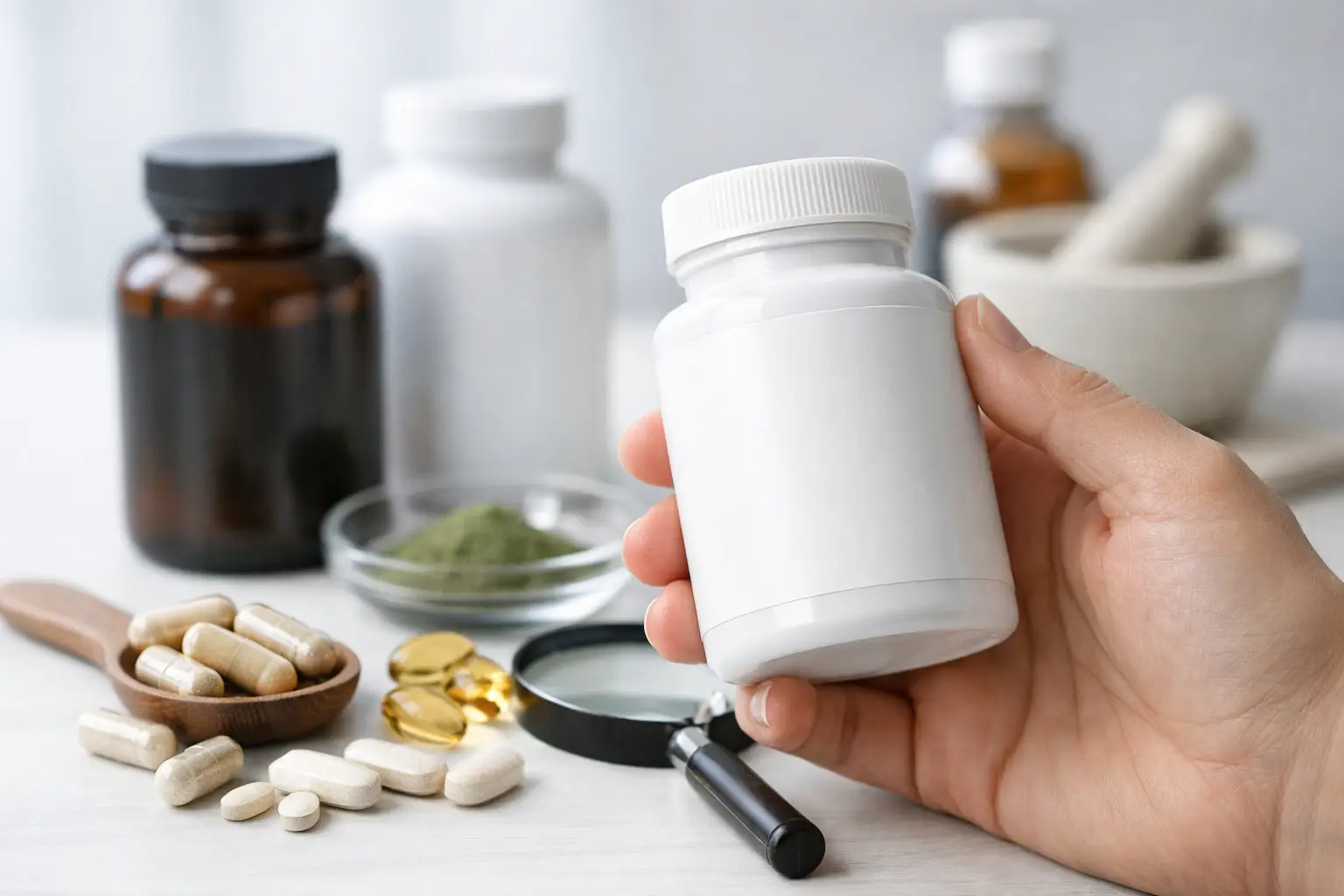
A bottle can make a meaningful promise in six words: metabolism support, natural energy, daily balance. The details that determine whether that promise deserves your trust are usually printed in much smaller type. Understanding supplement labels is less about memorizing every botanical name and more about knowing where to look, what to question, and when to ask a clinician for guidance.
For people building steadier routines around meals, movement, sleep, and metabolic wellness, a supplement should be one clear tool in a larger practice. Its label should make that role easier to understand, not harder.
Start With the Supplement Facts Panel
The Supplement Facts panel is the working document of the bottle. It tells you what a company is actually providing per serving, rather than what its front label hopes you will notice first.
Begin with serving size. A serving may be one capsule, two capsules, a scoop, or several tablets. This matters because the amount listed for each ingredient applies to that serving, not necessarily to a single capsule. If a label lists 1,000 milligrams of an ingredient but the serving is four capsules, ask whether that routine fits your day and whether the suggested use makes sense for you.
Next, look at the amount of every active ingredient. Transparent labels state the quantity clearly, usually in milligrams, micrograms, or international units. That number alone does not establish quality or effectiveness. It does, however, give you the information needed to compare products, assess total intake, and have a useful conversation with a qualified healthcare professional.
You may also see a percent Daily Value. For vitamins and minerals, this can help put an amount into context. For many botanical extracts and specialty compounds, a Daily Value has not been established. “Daily Value not established” is not automatically a warning sign. It simply means there is no official daily reference value for that ingredient.
Look for the Form, Not Just the Name
Two labels can name the same ingredient while offering meaningfully different forms. The form can affect how an ingredient is studied, standardized, tolerated, or combined in a formula.
Consider cinnamon. A label that says only “cinnamon” leaves important questions unanswered. Is it Ceylon cinnamon or cassia cinnamon? Is it whole powder, an extract, or a specific plant part? Similarly, “ginger” could refer to root powder or a concentrated extract with a stated level of gingerols, the naturally occurring compounds often measured in research.
For minerals, the attached compound matters. For botanicals, look for the botanical name, plant part, extract ratio when relevant, and standardization information if it is available. Standardization does not make an ingredient a guaranteed solution, but it can show that a manufacturer is trying to provide more consistency from batch to batch.
A clear label should answer practical questions without forcing you to guess. What is the ingredient? What form is it in? How much is there? If those answers are missing, the product may be harder to evaluate on its merits.
A note on extract ratios and percentages
An extract ratio, such as 10:1, describes the relationship between source plant material and finished extract. It can be useful context, but it is not a scorecard. A higher ratio is not always better, and ratios are difficult to compare without knowing the extraction method and the compounds being measured.
A stated percentage of a marker compound can be more informative in some cases. Even then, the most meaningful question remains: is the ingredient identity, amount, and intended role explained in a way that is specific and responsible?
Be Careful With Proprietary Blends
A proprietary blend groups multiple ingredients under one total amount while withholding the amount of each ingredient. For example, a blend might contain 800 milligrams of five herbs, but the consumer cannot tell whether the ingredient they care about is present at 500 milligrams or 5 milligrams.
This format does not prove a product is poor quality. Some companies use it to protect a formula they consider distinctive. But it limits your ability to compare products, evaluate dosage, and account for ingredients you may already take elsewhere.
For adults managing a full supplement cabinet, that lack of clarity can create unnecessary uncertainty. You may be trying to avoid a specific herb, watch your total caffeine intake, or understand whether a product contains a meaningful amount of a particular extract. Full disclosure supports better decisions. Proof, not placeholders, should be the standard.
Separate Structure Claims From Medical Claims
Supplement labels are allowed to describe how an ingredient may support normal body structure or function. You may see language such as “supports healthy glucose metabolism,” “helps maintain digestive comfort,” or “supports liver health.” These are not the same as claims to diagnose, treat, cure, or prevent a disease.
That distinction can feel technical, but it protects clear thinking. “Supports healthy blood sugar already in the normal range” is different from a promise to treat diabetes. “Supports energy metabolism” is different from a claim to resolve persistent fatigue.
Be especially cautious when a label implies dramatic outcomes with broad, absolute language. Phrases like “melts fat,” “resets your metabolism,” or “works instantly” make health sound like a switch that can be flipped. Metabolic wellness is more often shaped by repeated, ordinary choices: meals that satisfy, movement you can sustain, sleep that is protected, and care that reflects your individual health history.
The standard supplement disclaimer also deserves a read. It states that the product has not been evaluated by the Food and Drug Administration and is not intended to diagnose, treat, cure, or prevent disease. This does not mean every supplement is ineffective. It means the label is not a substitute for medical diagnosis or individualized treatment.
Read the “Other Ingredients” With the Same Care
The active ingredients get the spotlight, but the “Other Ingredients” section matters too. This is where you may find capsule materials, binders, flavors, sweeteners, colorants, oils, or flow agents.
For many people, these ingredients are not a concern. For others, they can affect tolerability, dietary preferences, or allergies. Someone avoiding gelatin may prefer a vegetable capsule. Someone sensitive to certain sweeteners may want to inspect a powdered drink mix more closely. If you have a known allergy, do not assume “natural” means suitable. Read allergen statements and contact the manufacturer when information is unclear.
This section also gives you a sense of formulation discipline. A longer list is not inherently bad, particularly for gummies, powders, or liquids. Still, every ingredient should have a practical purpose. A label that is straightforward about both active and inactive ingredients earns more confidence than one that treats disclosure as fine print.
Check Quality Signals, Then Put Them in Context
Manufacturing standards matter because a label is only useful if the bottle contains what it says it contains. Look for signs that the company follows current Good Manufacturing Practices, often written as cGMP or GMP. US-based GMP-certified manufacturing can be a meaningful quality signal, though it is not a guarantee that a particular product is right for you.
Some brands also use independent testing or provide certificates of analysis. These practices can help verify identity, purity, and, depending on the testing, the absence of certain contaminants. Still, do not let a single seal do all the thinking for you. Ask what is being tested, how often, and whether the company explains its standards plainly.
Transparency should extend beyond a badge. Responsible companies disclose ingredient amounts, avoid vague formula language, explain intended use without inflated promises, and make it possible to identify the manufacturer or distributor. Trust should be earned in public.
Put Safety Above a Marketing Promise
The right label can help you identify when to pause. Review the suggested use and warnings before you begin, especially if you are pregnant, breastfeeding, preparing for surgery, managing a medical condition, or taking prescription medication.
Botanicals can be active compounds, not decorative plants. Ingredients that influence digestion, glucose metabolism, blood pressure, or liver enzyme activity may be relevant to your medication plan. Combining several products with overlapping ingredients can also raise your total intake beyond what you intended.
A pharmacist, physician, or other qualified clinician can help you assess interactions in the context of your health history. This is particularly worthwhile for anyone using glucose-lowering medication, anticoagulants, blood pressure medication, or treatments with narrow dosing ranges. Physician-guided does not mean a bottle replaces medical care. It means sound guidance belongs in the process.
Understanding Supplement Labels Means Asking Better Questions
You do not need a degree in nutrition science to read a label well. You need a calm, repeatable filter. Can you see the amount of each active ingredient? Is the form identified? Is the serving size realistic? Are the claims proportionate to what the product can reasonably support? Does the company explain quality and safety without hiding behind buzzwords?
A supplement may fit your routine when it is transparent, tolerable, and aligned with a goal that does not depend on overnight change. It may not fit when the formula is opaque, the promises are oversized, or the suggested use ignores your health context.
The next time you hold a bottle, give the small print the same attention as the front-label promise. A clear label will not create your wellness rhythm for you, but it can help you choose one tool with fewer assumptions and more intention.