Observe
Take Burn only according to its marketed label. Notice Movement, Diet, Stress, Sleep, and Spirituality without trying to overhaul them all. Energy and digestion may be observed privately.
Your Burn 30-Day Practice
This month is not a race toward a dramatic result. It is a chance to take Burn only as directed, notice your everyday foundations, and practice one realistic action long enough to learn from it.
The shape of the month
The 30-Day Practice keeps the focus on your actual routine. It does not ask you to prove a body transformation or connect every reflection to the supplement.
If you miss a day, simply return to the next reasonable opportunity. Consistency is information—not a test of character.
Take Burn only according to its marketed label. Notice Movement, Diet, Stress, Sleep, and Spirituality without trying to overhaul them all. Energy and digestion may be observed privately.
Choose one foundation and make the action small enough to repeat. Let ordinary days—not perfect days—show you whether it fits.
Ask what became easier to remember, what felt unrealistic, and what single practice deserves another week. No promised outcome is required.
Choose one foundation
Pick one of CoreVital's five MDSSS foundations—or write your own version. The right practice is specific, safe for you, and realistic enough to repeat without crowding out medical care or your clinician's advice.
Pair a sustainable, clinician-appropriate period of activity with an existing cue. Movement gives the body a physical outlet and can support a steadier metabolic rhythm.
Choose one nourishing eating pattern you can repeat on an ordinary day, giving the body a steadier and more predictable fuel signal.
Choose one repeatable wind-down signal. Sleep supports recovery and the timing of many biological processes without asking you to perform a perfect night.
Use one ordinary transition as a cue for a brief pause. The aim is to notice when the alarm section has been playing too loudly—not to blame yourself for hearing it.
Choose prayer, remembrance, reflection, nature, community, service, or another authentic way of becoming more settled and connected.
Write one action in plain language: “After ___, I will ___ for ___.” Make it smaller if you would not do it on a busy day.
Week 3 · Stress + Spirituality
The orchestra is a way to understand connection—not a claim that every body system is literally an instrument or that one practice controls the whole.
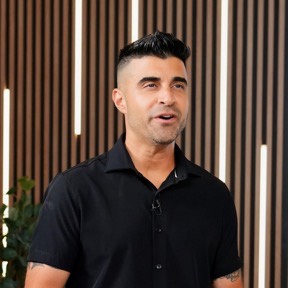
As a musician, I’ve spent my life chasing harmony. The body isn’t so different. Your brain, hormones, immune system, and metabolism are all playing in the same orchestra. When one section plays too loudly for too long, the whole piece can drift out of tune. Health isn’t about silencing one instrument. It’s about helping the whole system find its rhythm again.

Ozzie’s right about the rhythm. Psycho-neuro-immunology, or PNI, studies how thoughts, emotions, the nervous system, hormones, and immune signaling influence one another. It is network physiology—not magic.
Amit Goswami’s The Quantum Doctor helped inspire the question behind this conversation; the physiology described here comes from established PNI and endocrinology—not from quantum physics, and not as proof that thoughts alone control health.
The brain begins coordinating a response when something feels urgent. That response is adaptive; it is not evidence that a person failed to think positively.
The sympathetic nervous system helps drive the fast response. Heart rate, blood pressure, airway activity, and available glucose can change to help the person act. Short-term stress signaling can be useful.
The hypothalamus, pituitary, and adrenal cortex coordinate a longer response; cortisol helps sustain it. Prolonged stress may influence sleep, appetite, glucose regulation, insulin sensitivity, mood, and immune balance without determining one fixed outcome.
The scientific boundary
Listening to your body is not the same as blaming yourself for what it does. Positive thinking does not cure disease, spirituality does not control immunity, and Burn is not an immune treatment. People cannot control every stressor, illness, or biological response.
Seven-day Mind–Body Recovery Practice
Choose one practice that feels authentic and repeatable: prayer or remembrance, quiet reflection, slow breathing, meditation, an unhurried walk, time in nature, supportive human connection, gratitude, an act of service, or a calming transition before sleep.
The purpose is to notice what happens immediately after a repeatable practice. It is not an immunity experiment, a hormone measurement, a treatment, or another standard against which you can fail.
Mark only whether you completed the practice today.
Describe the immediate experience without assigning a biological cause.
Notice whether it helped you take the next healthy action.
Seven-day reflection
At the end of each day, mark whether the action happened and add one short observation. Digestion, energy, and tolerability remain optional observations—not substitutes for Movement, Diet, Stress, Sleep, or Spirituality.
You do not have to fix every section at once. Notice what felt loud or out of rhythm, name the small practice that helped you settle, and return without trying to catch up.
Day 30 reflection
What became easier to remember? What did a normal week reveal? Which action was too large? What single practice would you willingly repeat for seven more days? Your answer can be “none yet.” The purpose is to make the next choice more honest—not to manufacture a success story.
This page provides general wellness education only. It does not provide medical advice, diagnosis, treatment, individualized recommendations, emergency support, or a physician-patient relationship. Follow the marketed Burn label, and ask your clinician or pharmacist before use if you take medication, use other supplements, manage a medical condition, are preparing for surgery, or have a safety concern.